Writing copy that earns trust in a regulated industry
Writing campaign copy for a credit rating agency is not like writing campaign copy for a SaaS startup. Every claim has a compliance owner. Every superlative needs a footnote. "The best" and "the leading" require qualification. The copy that survives to publication is the copy that does its job inside those constraints, and the job is still the same: give the right person a reason to pay attention.
The three campaigns below represent different briefs, audiences, and creative challenges. In each case, the goal wasn't to be clever for its own sake. It was to say something true and specific that the target buyer would actually notice.
The constraint
All copy for Morningstar DBRS and Morningstar Credit goes through legal and compliance review before publication. Claims must be accurate and substantiated. Comparative language is scrutinized. The copy that runs is the copy that survives that process, which means you have to build the argument into the brief, not fight for it at the end.
50th anniversary campaign
Audience: Institutional investors, issuers, and market participants across North America, EMEA, and APAC ·
Goal: Brand awareness and positioning reinforcement ·
Format: LinkedIn social post with hero image; anniversary microsite
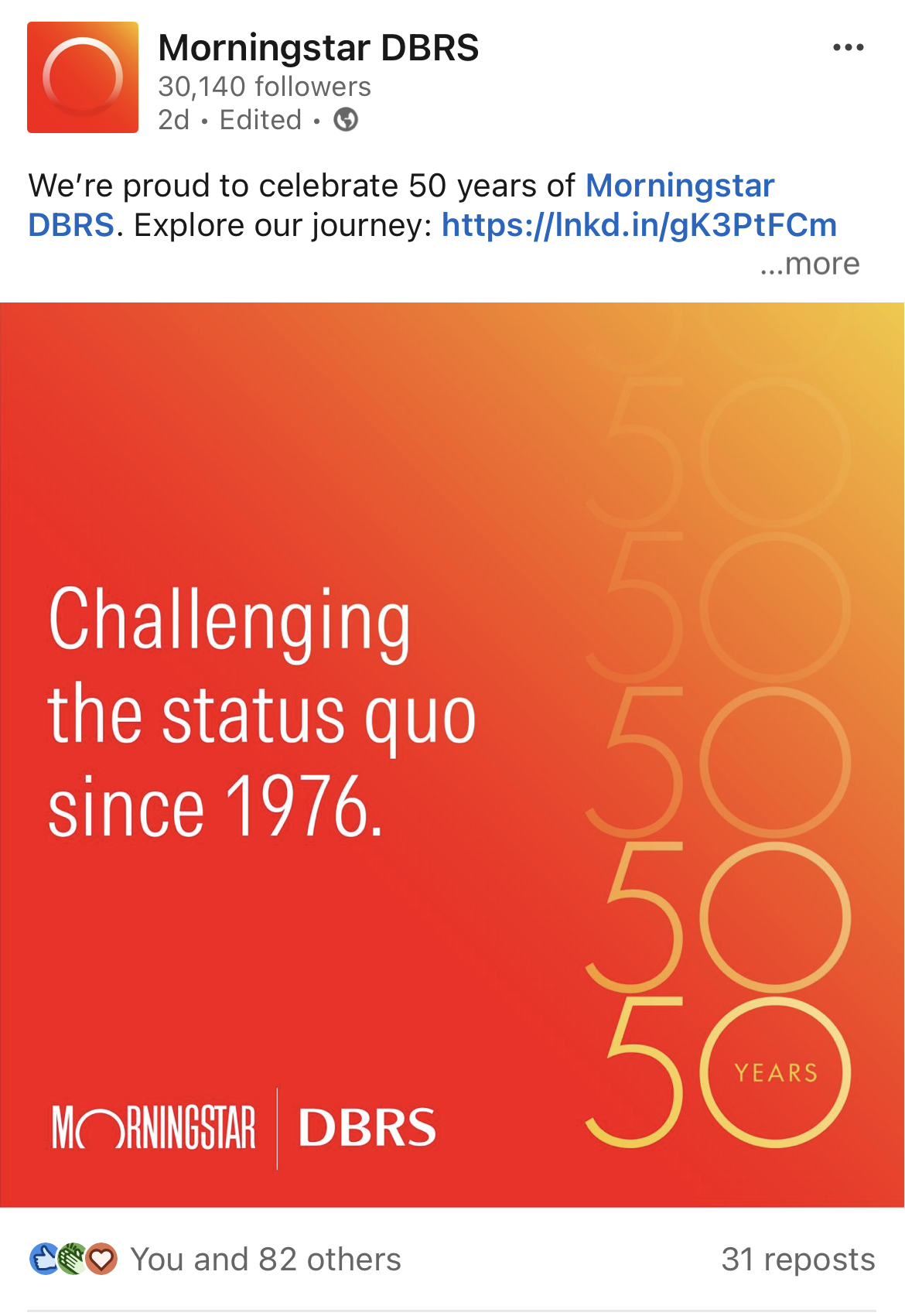
Morningstar DBRS turned 50 in 2026. The standing brand line is "The next generation of credit ratings," a forward-looking position built on the idea that there's a better, more agile alternative to the three agencies that have dominated global credit ratings for decades. The anniversary campaign needed something that could sit alongside that line: specific to the milestone, but consistent with the same challenger identity.
The temptation with anniversary campaigns is to celebrate longevity. That's the wrong instinct here. Leaning into heritage and tenure risks sounding like exactly what Morningstar DBRS is trying to differentiate from. The brief became: what does 50 years actually mean for a brand in our position?
Challenging the status quo since 1976.
Fifty years of longevity reframed as fifty years of contrarianism. It complements "The next generation of credit ratings" without repeating it: one line says what the brand is aiming for, the other says what it's been doing all along to get there. The supporting post copy closes with "Here's to the next 50 years of independent credit ratings and market-moving perspectives," connecting the milestone to impact rather than just existence.
CRE Loan Explorer campaign
Audience: CRE analysts, portfolio managers, and loan officers at banks and investment firms ·
Goal: Demo requests via LinkedIn ·
Format: LinkedIn single-image ads, 2 variants
Morningstar Credit's CRE Loan Explorer is a commercial real estate data platform for analysts, loan officers, and portfolio managers who need to find, filter, and compare loan and property data quickly. The brief was to drive demo requests from CRE professionals: a sophisticated audience skeptical of generic financial technology marketing.
Two variants were developed and tested on LinkedIn. Both use "Discover" as the lead verb deliberately: it echoes "Explorer" in the product name, creating a semantic connection between the action in the ad and the identity of the tool. The variants diverge from there; one names specific buyer jobs to qualify the click, the other leads with opportunity to pull in buyers earlier in their decision process.
Variant A · buyer-job framing
Variant B · aspirational framing
BNY Global Collateral Platform campaign
Audience: Institutional investors, portfolio managers, treasurers, and risk officers ·
Goal: Announce the integration; reinforce Morningstar DBRS as a credible alternative to legacy agencies ·
Format: LinkedIn organic post with CEO quote; 300x250 display ads (3 variants)
In January 2026, BNY integrated Morningstar DBRS credit ratings into its Global Collateral platform, expanding the universe of eligible securities available for triparty asset allocation. The announcement needed to land with institutional buyers who would understand exactly what the integration meant for their operations.
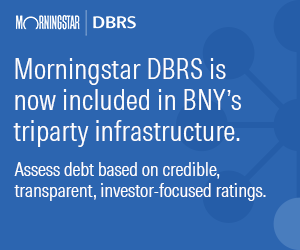
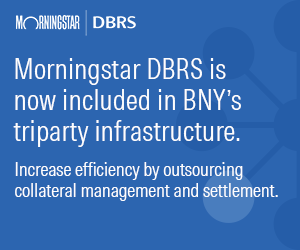
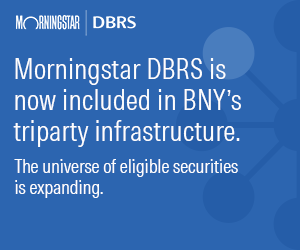
The LinkedIn post was anchored by a CEO quote written to do competitive work: "sophisticated institutions want more than the legacy ratings playbook" is a pointed positioning statement, credible because it's attributed and memorable because it says something the audience actually thinks. Three display ad variants supported the announcement, each leading with a different angle for a different buyer: the news itself, the operational benefit, and the values case for independent ratings.
Variant A · news-led
Variant B · ops-focused
Variant C · values-led
What this work demonstrates
Financial services copywriting is a constraint problem before it's a creativity problem. The copy that runs is the copy that survives legal review, accurately represents the product, and still gives a sophisticated buyer a reason to click. Getting all three right at once is the job.
These campaigns also show A/B thinking in practice. The CRE and BNY variants weren't just executions; they were strategic choices about which angle would land with which buyer at which stage of their decision. Utility versus aspiration. Operations versus values. The variant isn't an accident, it's a hypothesis.
The 50th anniversary line is the one I'm most proud of. It came from asking the right question: not "how do we celebrate 50 years?" but "what does 50 years actually mean for a brand in our position?" The answer was already in the brief. I just had to find it.